

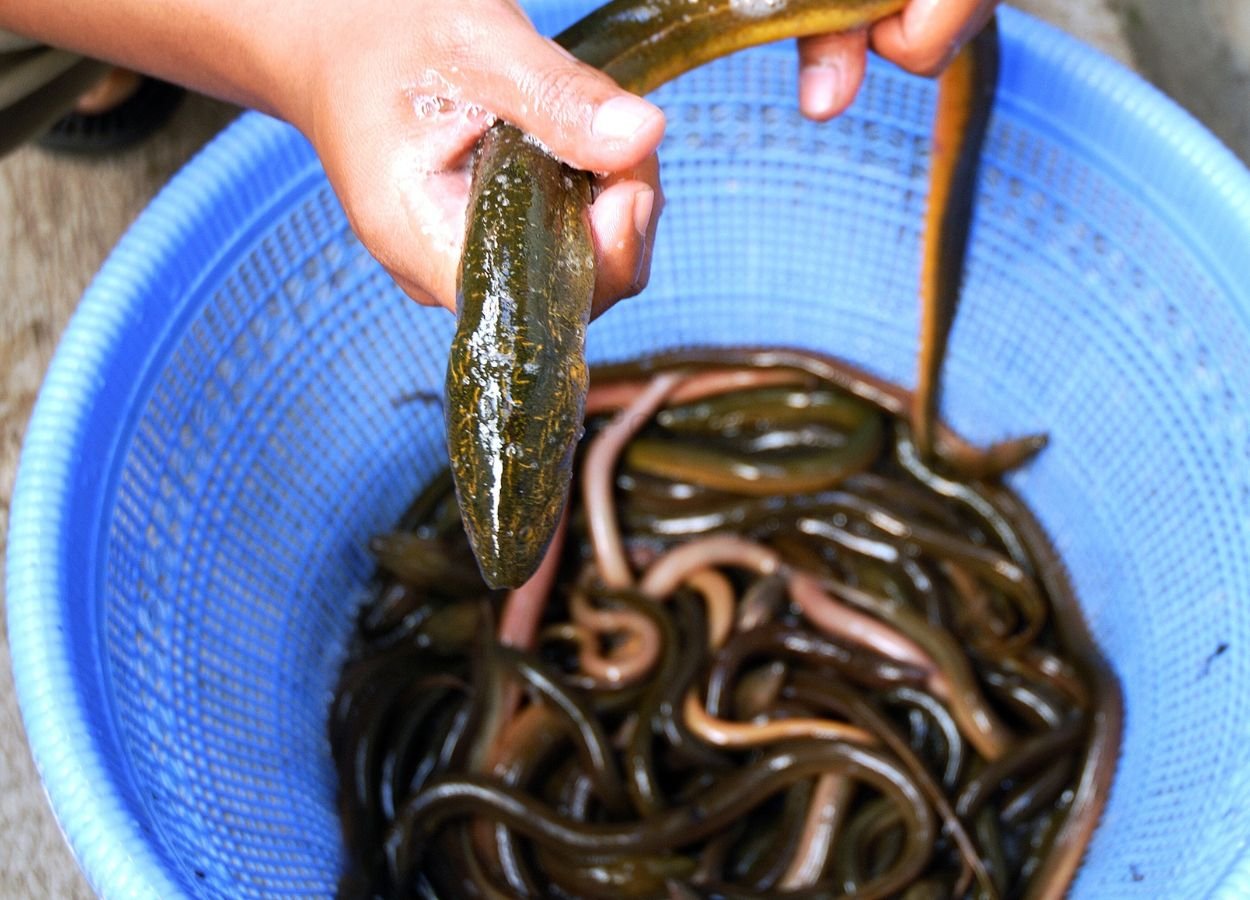
Rice eel farming in Xiantao, Hubei Province, China, has grown into a multibillion-yuan industry and is beginning to expand into markets around the world. The commodity, which has long been part of Chinese cuisine, is now being developed through advanced farming technology, processing systems, and digital traceability.
Xiantao is known as one of the major breeding and farming centers for rice eels in Hubei. Local industry data shows that the area accounts for about one-quarter of China’s rice eel production. The industry began developing more than 30 years ago when farmers experimented with raising eels in cages placed in ponds.
The business initially faced pressure as more producers across China entered the same sector. Oversupply eventually pushed prices down, prompting some farming communities to stop eel cultivation.
Xiantao, however, continued to maintain the industry. In Xianfeng Village, for example, most agricultural land has been converted into ponds. The village now produces around 1 billion rice eels each year.
The growth of the industry has made Xiantao home to China’s largest rice eel processing company and one of the country’s major trading centers for the commodity. The annual output value of the city’s rice eel industry has exceeded 12 billion yuan.
Technological advances have also helped increase productivity. Researchers from Huazhong Agricultural University and the Institute of Hydrobiology are working with industry players to develop large-scale artificial breeding and controlled-environment aquaculture systems.
The technology enables more precise control of water quality and temperature, reducing dependence on seasonal conditions. The system also helps address extreme weather and reduce threats from predators. The survival rate of young eels in laboratories has increased from around 50 percent to 90 percent.
The industry’s challenge now is not only increasing production but also expanding consumption beyond Asia. In the first half of this year, Xiantao exported more than 125 tons of frozen rice eels and processed eel products to more than 10 countries and regions, including North America, Australia, Japan, South Korea, and Southeast Asia.
Industry players are also developing products such as grilled eel and eel steaks to accommodate international consumer preferences. Digital systems covering breeding, farming, feeding, and processing are also being implemented so consumers can trace the product’s journey.
Further technological development is also focusing on automation. Unmanned vessels developed in collaboration with several Chinese universities are designed to assist with feeding and removing leftover food from ponds, allowing farmers to improve farming efficiency.

Rizky Mahendra is a political and current affairs journalist at RakyatPost specializing in government policy, public affairs, and regional developments across Indonesia and Southeast Asia. With a strong interest in responsible journalism and fact-based reporting, he covers political trends, social issues, and breaking news with clarity and depth. Rizky is dedicated to delivering accurate, balanced, and reader-focused stories that help audiences better understand today’s rapidly changing world.